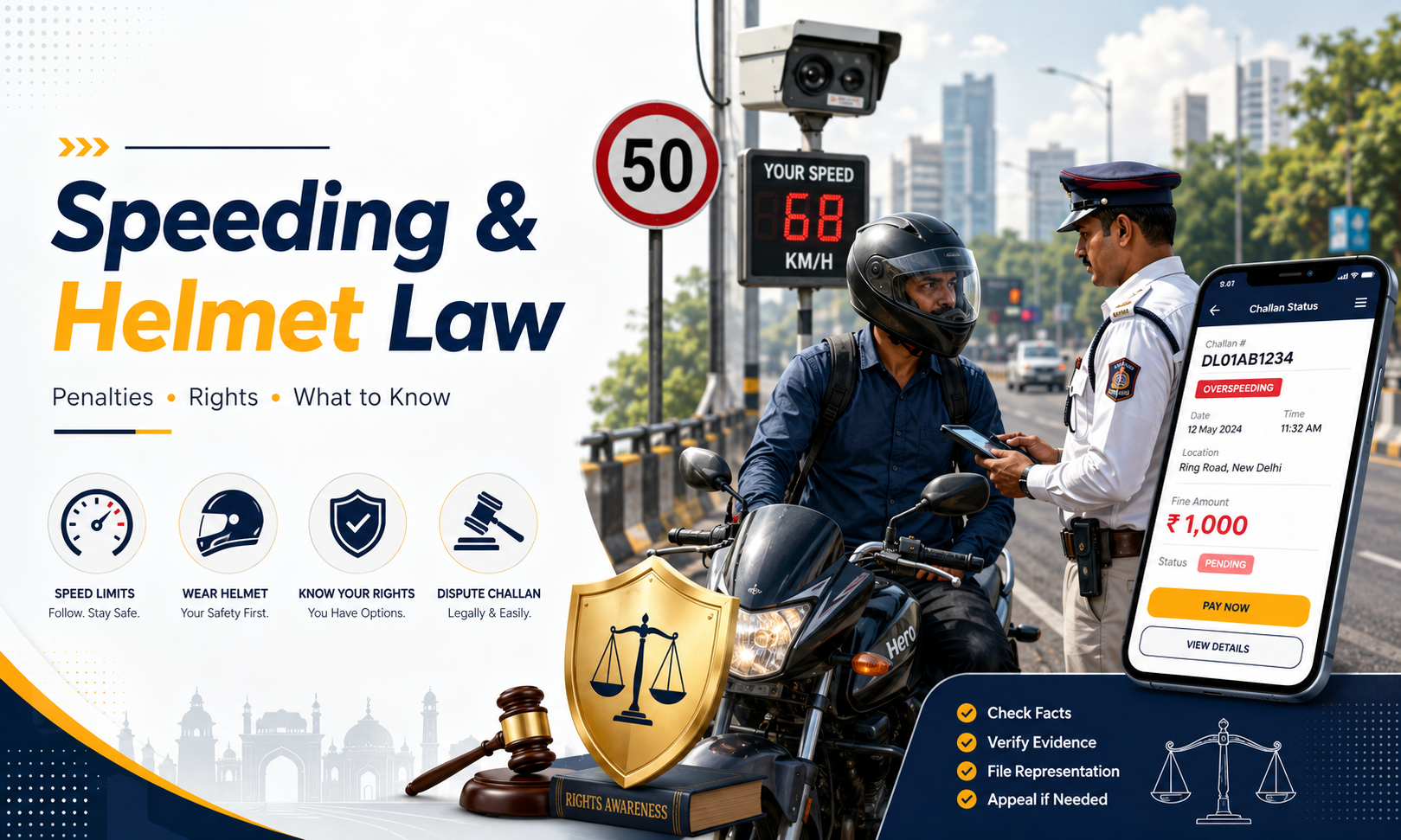
Every year, thousands of road accidents in India are linked to excessive speed and the failure to wear protective helmets. To improve road safety and encourage responsible driving, traffic authorities have strengthened enforcement through the Motor Vehicles Act and the nationwide e-Challan system. Today, violations such as over speeding challan and helmet challan are detected not only by traffic police but also through AI-enabled cameras, speed detection devices, and automated surveillance systems.
If you own a car, motorcycle, or commercial vehicle, understanding these traffic violations is essential. Knowing when a challan can be issued, what your responsibilities are, and how to respond can help you stay compliant with the law while ensuring your own safety.
Why Over-Speeding Is Taken Seriously
Speed limits are not arbitrary numbers. They are determined based on road conditions, traffic density, pedestrian movement, and accident history. Driving beyond the prescribed limit significantly increases the chances of losing vehicle control and reduces the time available to react to unexpected situations.
An over speeding challan may be issued when:
- Your vehicle exceeds the notified speed limit.
- Speed detection cameras capture the violation.
- Traffic police record the offence using handheld speed monitoring devices.
- Smart surveillance systems automatically identify the violation.
Modern traffic enforcement allows authorities to issue digital challans even if the driver is not stopped immediately.
Understanding Helmet Challans
Wearing a helmet is one of the simplest and most effective ways to reduce the severity of injuries during a road accident. Indian traffic laws require both riders and pillion passengers, where applicable, to wear protective helmets while riding a two-wheeler.
A helmet challan may be issued in situations such as:
- Riding without wearing a helmet.
- Wearing a helmet that does not meet the required safety standards.
- Wearing the helmet without fastening the chin strap properly.
- Allowing a pillion rider to travel without a helmet where legally required.
Traffic authorities continue to increase enforcement because helmets play a critical role in reducing fatal head injuries.
How Traffic Authorities Detect These Violations
Technology has transformed traffic management across India. Instead of relying solely on manual inspections, authorities now use advanced systems to identify violations quickly and accurately.
These include:
- Speed detection cameras.
- CCTV surveillance.
- Automated Number Plate Recognition (ANPR).
- AI-based traffic monitoring.
- Mobile enforcement units.
- Handheld digital challan devices.
Once a violation is recorded, the challan is linked to the vehicle registration number or driver's details, allowing authorities to maintain digital records.
What Should You Do If You Receive a Challan?
Receiving a challan does not necessarily mean you should immediately assume everything is correct. The first step is to verify the details carefully.
Review:
- Vehicle registration number.
- Date and time of the offence.
- Location of the violation.
- Type of offence mentioned.
- Available photographic or video evidence, where applicable.
If the challan accurately reflects the violation, resolving it promptly is advisable. If you believe an error has occurred, you should gather relevant documents and follow the prescribed legal procedure.
Can an Over-Speeding or Helmet Challan Be Incorrect?
Although digital enforcement systems are designed for accuracy, mistakes may occasionally occur.
Possible reasons include:
- Incorrect number plate recognition.
- Technical errors in surveillance equipment.
- Duplicate challans for the same incident.
- Poor image quality.
- Incorrect vehicle identification.
If you believe the challan has been issued incorrectly, preserve all supporting documents and seek clarification through the appropriate legal or administrative channel.
Consequences of Ignoring Traffic Challans
Many drivers delay resolving traffic challans, assuming there will be no immediate impact. However, pending challans may create several legal and administrative challenges.
Ignoring traffic violations can result in:
- Additional penalties.
- Continued pending records.
- Legal notices in certain cases.
- Compliance issues for commercial vehicles.
- Delays in vehicle-related administrative procedures.
Addressing challans promptly helps avoid unnecessary complications and keeps your vehicle records up to date.
Practical Tips to Avoid Traffic Violations
Safe driving habits significantly reduce the likelihood of receiving traffic challans.
You can minimise risks by:
- Following posted speed limits.
- Wearing an approved safety helmet correctly.
- Ensuring the helmet strap is securely fastened.
- Wearing seat belts while driving.
- Obeying traffic signals.
- Avoiding mobile phone usage while driving.
- Maintaining valid insurance and vehicle documents.
- Driving responsibly in school zones and residential areas.
Road safety begins with consistent compliance rather than occasional caution.
Why These Rules Matter Beyond Penalties
Traffic regulations are intended to save lives, not simply collect fines. Research consistently shows that speeding increases accident severity, while properly worn helmets dramatically reduce the risk of fatal head injuries.
Every responsible driver contributes to:
- Safer roads.
- Lower accident rates.
- Better traffic discipline.
- Protection for pedestrians and passengers.
- Reduced emergency response burden.
Following traffic rules benefits not only the driver but every road user.
Legal Assistance in Challan-Related Matters
While many traffic challans are straightforward and can be resolved quickly, certain situations may involve disputed violations, repeated offences, licence-related concerns, or procedural issues. In such cases, professional legal guidance can help individuals understand the applicable laws, evaluate the available evidence, and determine the appropriate course of action.
Legal assistance may also be valuable for commercial vehicle owners and fleet operators managing multiple vehicles and ensuring compliance with transport regulations.
Conclusion
An over speeding challan or helmet challan is more than just a financial penalty—it serves as a reminder of the importance of responsible driving and road safety. As India continues to adopt advanced traffic monitoring technologies, drivers are expected to remain aware of the rules and comply with them at all times.
Regularly reviewing your vehicle records, maintaining valid documentation, respecting speed limits, and wearing proper safety gear can help you avoid unnecessary penalties while protecting yourself and others on the road. In cases where a challan appears incorrect or raises legal concerns, seeking timely legal advice can help ensure that your rights are protected and the matter is resolved appropriately.
