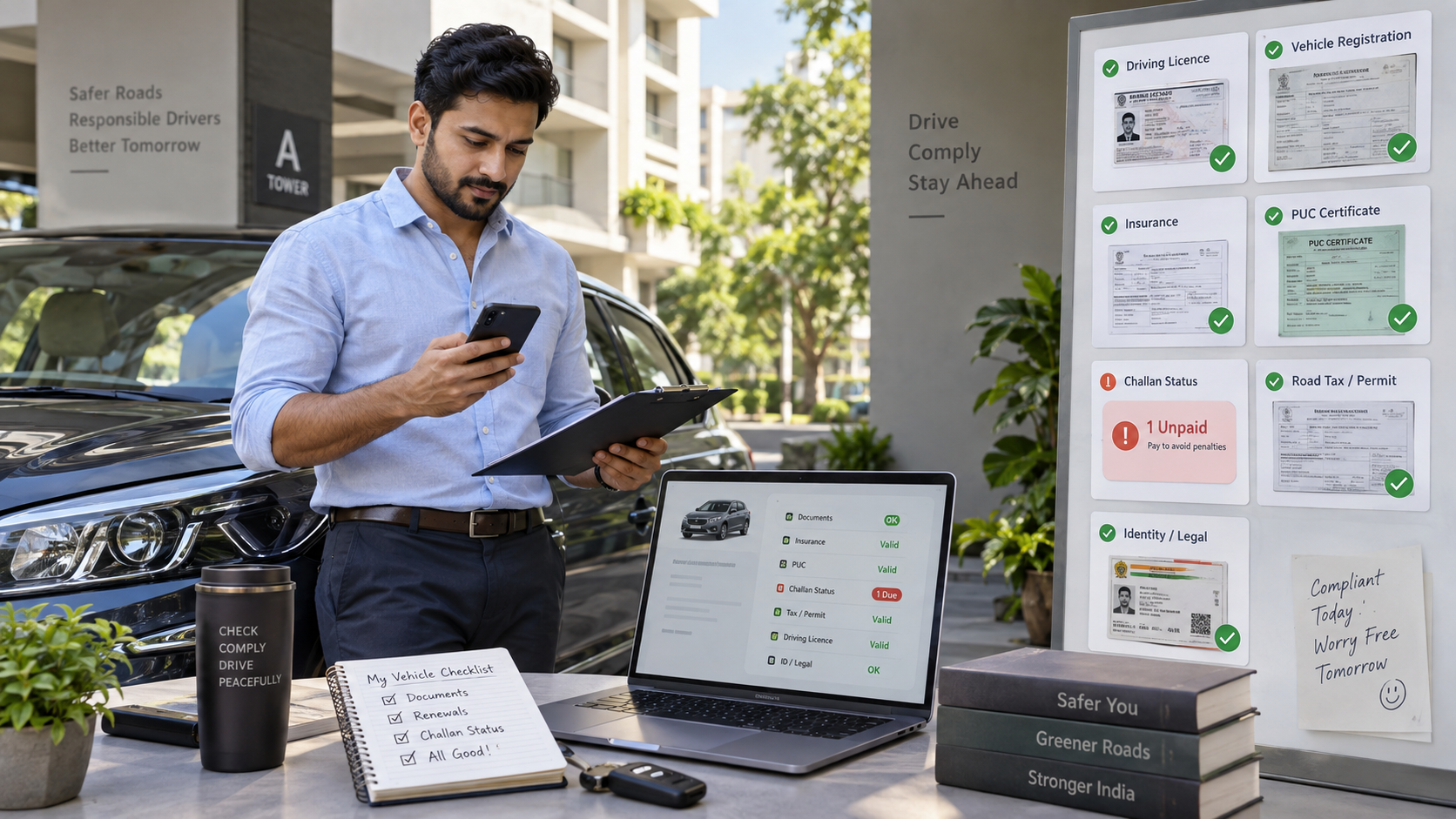
For many vehicle owners, compliance begins and ends with avoiding a traffic challan. But modern vehicle enforcement in India is moving beyond individual violations. Driving licence records, registration details, insurance, pollution certificates, taxes and traffic offences can all become part of a vehicle's broader digital compliance profile.
That makes regular checking more important in 2026.
A vehicle can appear perfectly normal on the road while one expired document or unresolved record creates trouble during a traffic check, vehicle transaction or transport-related service.
Here are seven areas every driver should review regularly.
1. Pending Traffic Challans
The first check should be obvious: does your vehicle have any unpaid challans?
The official eChallan system allows users to check pending challans using vehicle or challan details. It also displays information such as the challan date, amount, status, owner and offence details.
Do not rely only on SMS alerts. A notice can be missed because of an outdated mobile number, incorrect contact information or simply because the owner does not see the message.
A periodic vehicle challan check can help identify outstanding issues before they become a larger compliance problem.
2. Driving Licence Validity
A valid driving licence is not just a document to show during a traffic stop. It establishes whether the person operating the vehicle is legally authorised to drive.
Drivers should check the licence's validity, category and applicable restrictions. This becomes particularly important when someone regularly drives more than one type of vehicle or operates a commercial vehicle.
If your licence is approaching expiry, renewal should be planned rather than postponed until the last moment.
3. Registration Certificate and Vehicle Details
Your RC is effectively the vehicle's identity record.
Check whether the registration details accurately reflect the vehicle and owner. Pay attention to the registration number, owner's information and other relevant particulars.
This is especially important after purchasing a used vehicle, transferring ownership or making changes that require records to be updated.
A mismatch between the physical vehicle and its official records can create unnecessary questions during enforcement or administrative processes.
4. Motor Insurance
Driving without valid third-party insurance can create both legal and financial exposure.
Owners should regularly check the policy's expiry date rather than assuming that insurance automatically continues.
The broader digital transport ecosystem is increasingly designed to verify vehicle-related information electronically. Government transport systems can be used by enforcement personnel to validate information relating to registration, insurance, fitness and tax.
Keeping an updated insurance record is therefore part of basic vehicle compliance.
5. Pollution Under Control Certificate
PUC is another document that is easy to forget because it may have a shorter validity period than other vehicle documents.
Before a certificate expires, check the next renewal date and obtain a valid certificate where required.
This becomes even more important for owners who travel frequently between cities or states, because compliance checks can happen away from the vehicle's home location.
The Parivahan system also provides online PUC-related services, making it easier for owners to keep track of the requirement.
6. Road Tax, Fitness and Permit Requirements
This category is particularly important for commercial and transport vehicles.
Depending on the vehicle and its use, owners may need to maintain valid fitness certification, permits, road-tax payments and other regulatory requirements.
These are not simply administrative formalities. A vehicle used commercially can face operational disruption when a mandatory certificate or permit expires.
The government's current vehicle compliance framework also demonstrates how multiple requirements can operate together. For example, the 2025 Motor Vehicle Aggregator Guidelines require vehicles attached to aggregators to maintain valid registration, fitness, insurance, PUC and applicable taxes, among other requirements.
7. Outstanding Legal or Disputed Records
Not every compliance problem is about an expired document.
Sometimes the issue is a disputed challan, incorrect vehicle number, unresolved notice or a record that the owner believes is inaccurate.
In such cases, paying immediately may not always be the appropriate first step. Owners should first verify the offence, vehicle details and available information before deciding whether to pay or raise a grievance.
The official eChallan platform provides a grievance mechanism for challan-related issues.
If a matter involves repeated notices, ownership disputes, court proceedings or complicated legal questions, professional legal assistance may be appropriate.
Turn Compliance Into a Monthly Habit
Vehicle compliance does not need to become a complicated process.
Once a month, spend a few minutes checking:
- Pending traffic challans
- Driving licence validity
- RC information
- Insurance expiry
- PUC validity
- Tax, fitness and permit requirements where applicable
- Disputed or unresolved legal records
Also keep digital copies of important documents and payment receipts. Official guidance recognises digital versions of documents such as the driving licence, RC, insurance and PUC through platforms such as DigiLocker and mParivahan for traffic verification.
Why Regular Checks Matter in 2026
India's transport enforcement environment is becoming increasingly digital. The official eChallan platform itself now combines challan status, online payment, transaction verification and grievance-related services.
That means vehicle compliance is gradually shifting from a “check only when stopped” mindset to continuous digital record management.
A traffic fine may be a one-time inconvenience. An expired licence, invalid insurance, registration mismatch or unresolved legal record can create a much bigger problem.
For vehicle owners, the smarter strategy is simple: check your records before a problem forces you to.
Regular compliance checks can save time, prevent avoidable penalties and help ensure that your vehicle remains legally ready for the road, a sale, a transfer or any future transport-related requirement.
